Key Insights
- Many health system strategic initiatives underperform because they rely on historical data to predict future stakeholder behavior.
- Traditional analytics explain what happened but cannot reliably forecast how physicians, patients, employers, or payers will respond to new market conditions.
- In many specialty service lines, referring physicians—not patients—remain the primary drivers of where care is delivered, making referral behavior a critical strategic variable.
- Behavioral decision intelligence has proven to enable organizations to test strategic assumptions before investing capital, reducing uncertainty and improving investment decisions.
Every year, U.S. health systems invest billions of dollars in strategic initiatives—from expanding service lines and ambulatory networks to launching digital care models and redesigning pricing strategies. These investments are typically supported by extensive planning, including claims analyses, market share reports, surveys, interviews, and focus groups.
Yet many strategic growth initiatives still fail to deliver their expected results (70%, according to McKinsey & Company). Referral leakage continues, out-of-network migration persists, and newly built capacity often falls short of projected demand. The problem is not simply execution. More often than not, organizations make forward-looking decisions using backward-looking data.
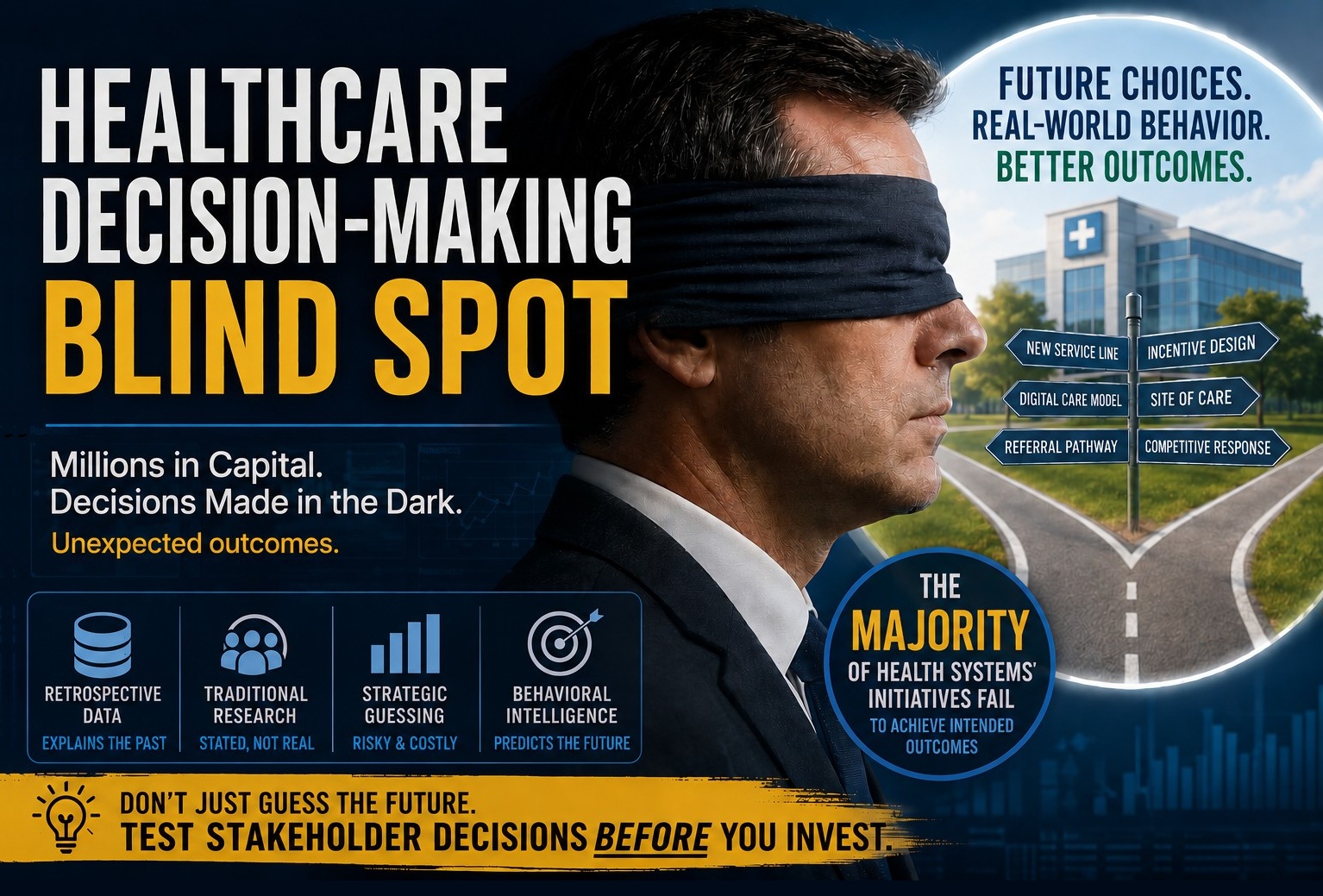
The Healthcare Decision Blind Spot
Traditional healthcare analytics are designed to explain yesterday's market—not predict tomorrow's. Claims data, utilization reports, and retrospective dashboards provide valuable operational insight, but they cannot reliably forecast how physicians, patients, employers, or payers will behave when presented with new choices, incentives, or competitive alternatives.
Likewise, conventional market research frequently measures what stakeholders say they might do rather than what they will choose when faced with real tradeoffs. As a result, healthcare leaders often allocate capital based on assumptions that have never been behaviorally tested using applied behavioral economics.
Referral Reality: The 80% Gatekeeper
One of the most common blind spots involves specialty care growth.
Many organizations focus expansion strategies on attracting patients through branding, digital engagement, and improvements in consumer experience. While these investments matter, behavioral decision modeling consistently demonstrates that, for many high-value specialty services, referring physicians control about 80% of referral volume, depending on the specialty and complexity of care.
When referral behavior is not incorporated into strategic planning, organizations risk investing heavily in patient acquisition while overlooking the behavioral factors that influence referral decisions. This is not simply a marketing challenge—it is a decision-making challenge.
Predicting Markets That Don't Yet Exist
Historical data cannot predict stakeholder behavior under conditions that have never existed, including:
- New service line launches
- Alternative care delivery models
- Competitive market entrants
- Changes in referral pathways
- Pricing or site-of-care redesigns
- New scheduling or access strategies
These decisions require understanding how stakeholders will respond—not simply how they responded in the past.
Replacing Assumptions with Behavioral Decision Intelligence
While uncertainty cannot be eliminated, it can be significantly reduced. By experimentally modeling real-world stakeholder behavior before implementation, healthcare organizations can:
- Test strategic assumptions before investing capital.
- Predict adoption and referral behavior.
- Identify hidden sources of market friction.
- Optimize service-line and operational design.
- Improve capital allocation and investment returns.
- Reduce the risk of costly strategic missteps.
Behavioral decision intelligence replaces assumptions with evidence. The result is greater confidence in strategic planning, improved capital allocation, and a reduced risk of costly investment mistakes. In future installments of the “Who Decides. What Matters.” series, we'll demonstrate how these behavioral models are developed, why they consistently predict real-world market behavior, and the results healthcare organizations have achieved by using them to guide high-stakes strategic and operational decisions.
Before launching your next strategic initiative, don't ask only, "What does the historical data tell us?"
Ask instead:
“Have we tested the behaviors that will determine whether this investment succeeds?”