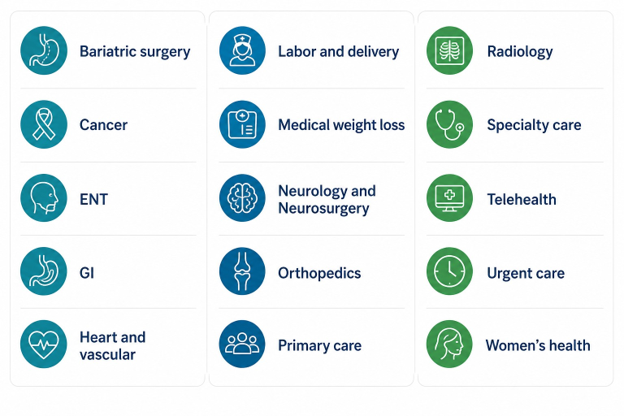
One of Mi4Sight’s™ most important differentiators is the proprietary Design Studio knowledge base developed through the implementation of more than 130 discrete choice experiments spanning major healthcare service lines and diagnostic, outpatient, and inpatient delivery models.
This experience has created more than methodological expertise. It has enabled the accumulation of a deep behavioral decision-intelligence asset on how healthcare stakeholders (including referring physicians and consumers) make complex strategic, financial, clinical, and operational trade-off decisions under real-world constraints.
Because the experiments have spanned multiple care settings and strategic contexts, Market Innovations’ design team has developed a highly refined understanding of how to architect experimental designs that accurately capture healthcare decision-making behavior — including the selection of attributes, calibration of levels, competitive framing, segmentation logic, and simulation structures.
The result is not simply a research capability, but an increasingly differentiated strategic intelligence system informed by thousands of observed healthcare tradeoff decisions across the evolving care continuum.
The design studio turns strategy into measurable, testable, and predictable outcomes.
It engages administrative and clinical leadership in a participatory design process that translates high-stakes decisions into structured experiments—revealing how physicians, patients, and payers will respond before execution.
Healthcare organizations do not struggle with ideas. They are limited by traditional healthcare data, which has a fatal built-in blind spot: It cannot accurately predict future human behavior.
-
- Will physicians refer differently under new site-of-care models?
- How will patients respond to access, wait times, or digital front doors?
- What pricing levels optimize both margin and volume?
- Which growth investments will truly shift demand?
Design Studio Process
From strategic decisions to behavioral experiment design
Define Critical Decisions
Step 1 of the Design Studio process is to define critical strategic and operational decisions.
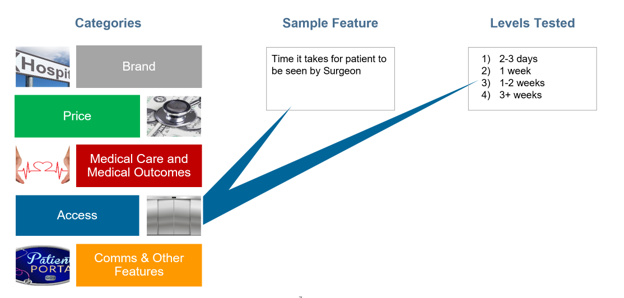
Decompose Strategy into Features and Levels
Step 2 decomposes strategy into its fundamental components—features and levels—and reconstructs them into realistic decision scenarios. The following illustrates the design categories, an example of an access feature, and their associated levels.
Select the Features and Levels for the Experiment
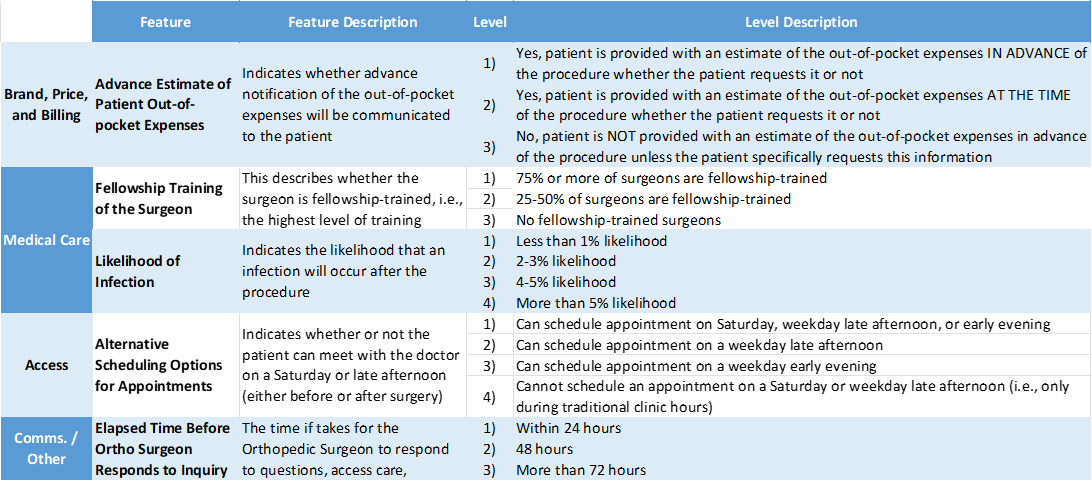
Step 3 involves the co-design team selecting the set of features and levels that represent the behavioral experiment. This is an example of 5 of the 17 features and levels created by an Orthopedic Joint Replacement design team focused on testing hypotheses for strategic growth.
The Design Studio library includes 130 designs that were developed to address questions at the overall healthcare system level, the service line level, as well as the individual procedure or diagnostic level. For example, the Design Studio contains a robust set of bespoke designs that describe diagnostic, outpatient, and inpatient procedures (e.g., ablation, breast cancer, ACL repair, cardiovascular surgery) spanning the following service lines: