

Mi4Sight™ — Turning Managerial Foresight into Evidence-based Market and Brand Decision Intelligence
Mi4Sight™ is MII’s integrated decision intelligence system, comprising three robust and rigorous approaches that address some of healthcare leaders' most important questions about committing people, capital, and strategy in markets defined by uncertainty and accelerating change.
It combines three complementary capabilities to provide a comprehensive view of future market performance, using strategic market simulation to create management foresight by understanding key drivers of behavioral economics, financial stressors, and brand strength. Mi4Sight™ is comprised of MII’s Strategic Integrated Market Simulation (SIM²), Brand Positioning Intelligence (BPI), and Capital Adequacy Stress Testing (CAST).
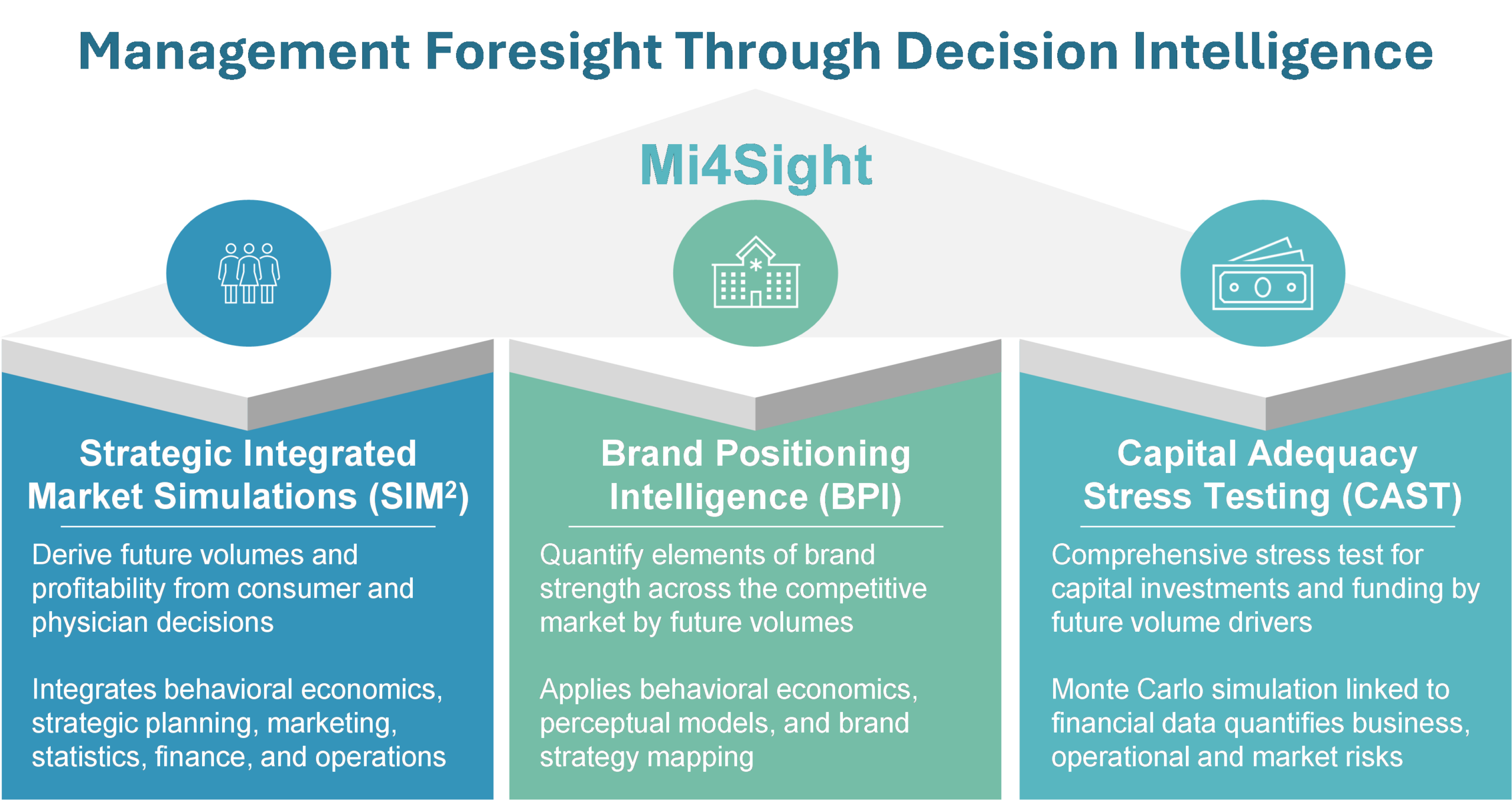
With Mi4Sight™, organizations can test strategies before committing resources—anticipating competitive responses, understanding stakeholder decision drivers, and assessing financial exposure under volatility. Thus, leadership can:
-
- Quantify how real decision-makers behave—patients, physicians, payors, competitors, and regulators—under alternative future conditions – and turn these insights into actionable strategic and operational insight
- Align strategy, market perception, and financial performance—turning uncertainty into a structured, evidence-based decision process
- Transform managerial foresight from an individual leadership skill into an enterprise and service line capability
- Strengthening confidence in major healthcare strategy and operational decisions
Together, these capabilities provide leaders with a unified view of strategy, market perception, and financial performance.
Unlike many other approaches typically available to and used by leadership, Mi4Sight™ has distinctive benefits that:
-
- Integrates three lenses that traditional analysis usually treats separately: market behavior, brand perception, and financial risk
- Models future decision behavior rather than relying only on historical utilization or trend projections
- Uses proprietary choice-based data to understand real trade-offs patients, physicians, and stakeholders make
- Connects market demand to brand equity and capital resilience, instead of analyzing each in isolation
- Tests multiple future scenarios and competitive responses, rather than producing a single static forecast
- Quantifies uncertainty and downside exposure, helping distinguish likely outcomes from vulnerable assumptions
- Links strategy to measurable business impact, including volume, revenue, market position, and financial sustainability
- Moves beyond descriptive analysis to show what could happen, why it may happen, and how resilient the organization is under different conditions
Strategic Integrated Market Simulation (SIM²)
Primary Purpose: Understand how decision-makers choose care or make referrals for patients—and how those choices shape future demand
Foundational Principles: Behavioral Economics and Strategic Market Simulation
Healthcare strategy often relies on projections based on historical utilization. But growth ultimately depends on how people behave in the future, given current or new medical options—how patients choose care, how physicians refer, and how competitors respond.
SIM² integrates behavioral economics with strategic simulation to model these real-world decision dynamics. Using proprietary choice-based data and advanced statistical modeling, the platform quantifies how stakeholders trade off factors such as brand reputation, access, clinical outcomes, pricing, communication, and convenience when selecting providers or services.
These insights power strategic market simulations that enable organizations to test alternative strategies before implementation. Leaders can evaluate growth or vulnerability defense strategies that focus on access, pricing, new service offerings, partnership opportunities, and competitive responses (and more!) across multiple potential market futures.
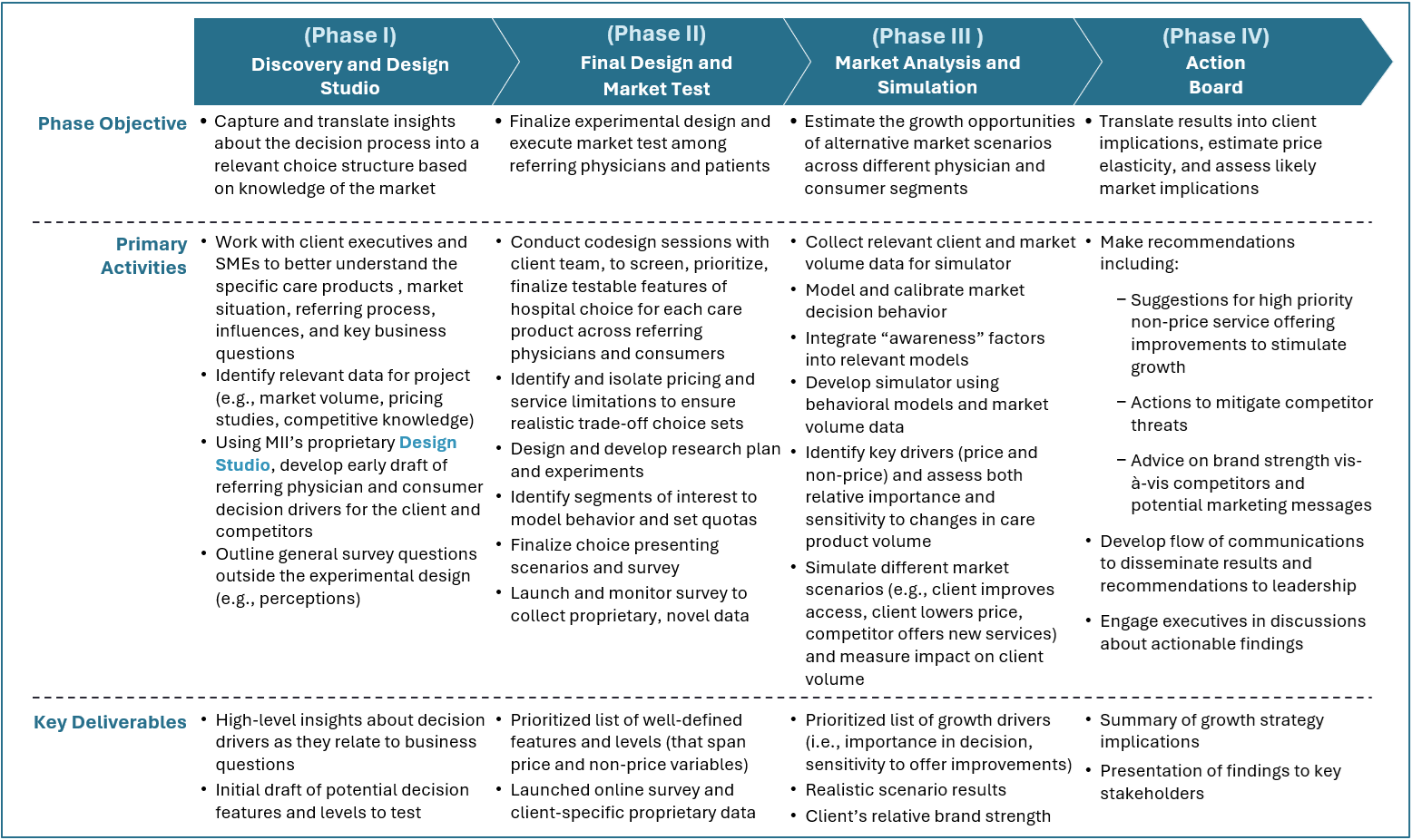
MII’s SIM² is based on well-defined, client-proven phases and detailed steps designed to glean the most from your knowledge, insights, and market acumen to develop personalized research specific to your business questions and market situation.
-
- Phase I: Discovery and Design Studio will translate the market’s decision process into a choice-based structure for your market
- Phase II: Final Design and Market Test is used to finalize an experimental design that extracts self—stated referring physician and patient decisions through a simulated, but realistic research method
- Phase III: Market Analysis and Simulation phase is designed to identify key decision drivers and estimate the volume impact of
- Phase IV: Action Board delivers insights and actionable recommendations based on realistic market simulations, client volume implications, and likely market changes (e.g., you redesign your offering or a competitor introduces a new medical option)
The result is a probability-weighted view of market outcomes—helping executives identify strategies that are robust across uncertainty, strengthen growth planning, and reduce blind spots in risk.
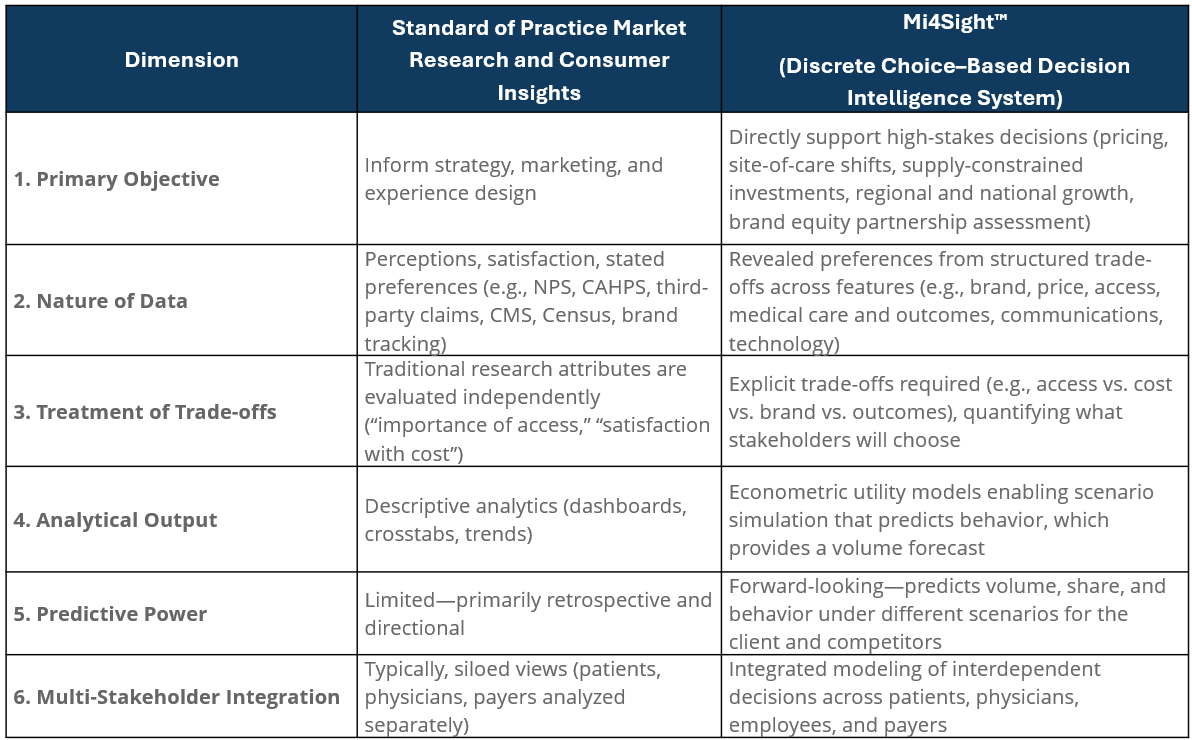
While conventional market research methods are highly effective for measuring perceptions, satisfaction, awareness, and retrospective experience, SIM² is designed to support high-stakes strategic and financial decision-making by quantifying how stakeholders make real-world trade-offs among competing attributes. The comparison demonstrates how behavioral design studio data complements and extends traditional research capabilities, providing a more rigorous foundation for pricing, growth strategy, service line investment, network design, brand positioning, and value-based healthcare decision.
Brand Positioning Intelligence (BPI)
Primary Purpose: Quantify the drivers of healthcare brand equity, brand strength, and brand associations that influence patient and physician choice
Foundational Principles: Behavioral Economics, Strategic Market Simulation, and Brand Mapping
Brand plays a decisive role in healthcare decisions—shaping how patients, physicians, employers, payers, and strategic partners perceive quality, trust, innovation, and care experience. Yet most organizations lack a quantified understanding of how brand influences demand and long-term market position
MII’s Brand Positioning Intelligence (BPI) capability measures the current strength, competitive differentiation, and future potential of a healthcare brand within a dynamic market environment. Through behavioral modeling and brand association analysis, BPI identifies the attributes that most strongly influence stakeholder choice and how each contributes to brand equity, market preference, and service line growth
This intelligence enables leadership teams to move beyond traditional brand awareness metrics to understand strategic investments—such as clinical innovation, physician alignment, partnerships, patient experience, digital engagement, or communication strategy—can reshape future market perception and service line demand.
The result is a strategic brand intelligence framework that connects brand associations, messaging priorities, competitive positioning and market impact. Organizations gain clarity on:
-
- Which attributes matter most of stakeholders
- How their brand compares to competitors
- Where perception gaps or competitive vulnerabilities exist
- Which investments are most likely to strengthen market preference and growth
By aligning marketing, service line strategy, innovation, and growth planning around quantified drivers of stakeholder choice, MII helps healthcare organizations build brands that are not only recognized but behaviorally preferred.
Capital Adequacy Stress Testing (CAST) - Ensuring strategic ambition aligns with financial resilience
Primary Purpose: Evaluate financial resilience and risk exposure before committing major capital investments that support disciplined governance, credit rating preservation, and resilient growth decisions
Foundational Principles: Monte Carlo Simulation across critical drivers of business risk, operational risk, and market risk
Healthcare organizations increasingly operate in an environment of significant financial uncertainty—from reimbursement volatility and inflationary pressures to labor disruption, operational risk, and capital market instability. As a result, major strategic investments must be evaluated not only for growth potential but also for financial resilience.
MII’s Capital Adequacy Stress Testing (CAST) capability applies advanced financial modeling and Monte Carlo simulation to assess how multiple risk factors may impact an organization’s capital position over time. Rather than relying on static forecasts or single-point assumptions, CAST models a range of potential future scenarios and quantifies the probability and magnitude of financial stress under varying market conditions.
CAST evaluates exposure across multiple risk categories—including business risk, operational risk, and market risk—to determine how strategic initiatives could affect reserves, liquidity, debt capacity, and long-term financial sustainability. This enables leadership teams to understand downside exposure, identify financial vulnerabilities, and evaluate the resilience of strategic plans before capital is deployed.
The result is a more disciplined and informed approach to growth strategy and capital allocation. By stress-testing investment decisions in advance, MII helps healthcare organizations preserve financial flexibility, strengthen enterprise resilience, and balance strategic ambition with prudent financial stewardship.