Key Insights
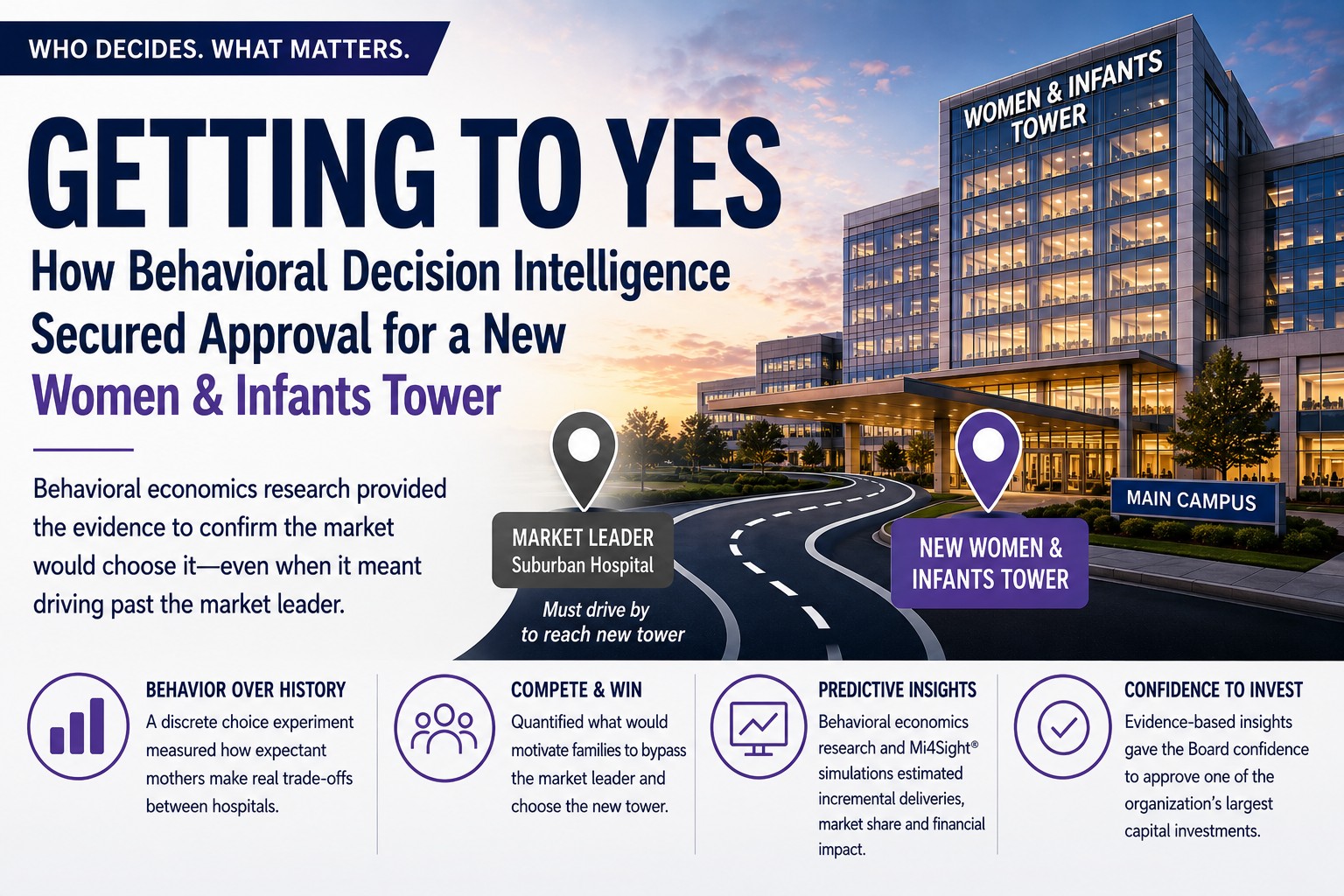
After two decades of stalled advocacy, behavioral decision intelligence helped healthcare executives transform a high-risk capital proposal into an evidence-based Board decision.
- Leadership replaced assumptions based on historical inference with evidence of future market behavior, advancing the proposal to secure approval
- Historical utilization data showed past choices but provided no clear indication of whether families would switch hospitals - and locations - for a new care model.
- The key question: would expectant mothers bypass an established suburban leader in favor of a new urban Women & Infants Tower?
- A discrete choice experiment quantified likely switching behavior and the factors most likely to influence delivery decisions.
- Predictive simulations estimated incremental deliveries, market-share gains, and financial performance across scenarios.
For more than two decades, a leading pediatric academic medical center’s Chief Medical Officer advocated for a Women & Infants Tower that would integrate labor and delivery with neonatal intensive care, pediatric subspecialists, maternal-fetal medicine, and enhanced patient amenities. The proposal repeatedly stalled because the Board required credible evidence that the tower would generate enough incremental deliveries to justify the hundreds of millions of dollars in construction costs.
Success hinged on whether expectant mothers would bypass the region’s established suburban labor and delivery leader in favor of an unbuilt urban facility. Historical utilization data reflected past choices, not future switching behavior in a market with no comparable facility.
The obstacle was not the vision but uncertainty.
Modeling a Market Before It Exists
MII designed a discrete choice experiment to simulate how families choose where to give birth. Women of childbearing age evaluated realistic delivery options that varied by affiliation, out-of-pocket costs, NICU capabilities, patient safety, room guarantee, family sleeping options, convenience, and patient satisfaction. Their choices indicated whether the proposed tower offered sufficient value to overcome the incumbent’s advantage.
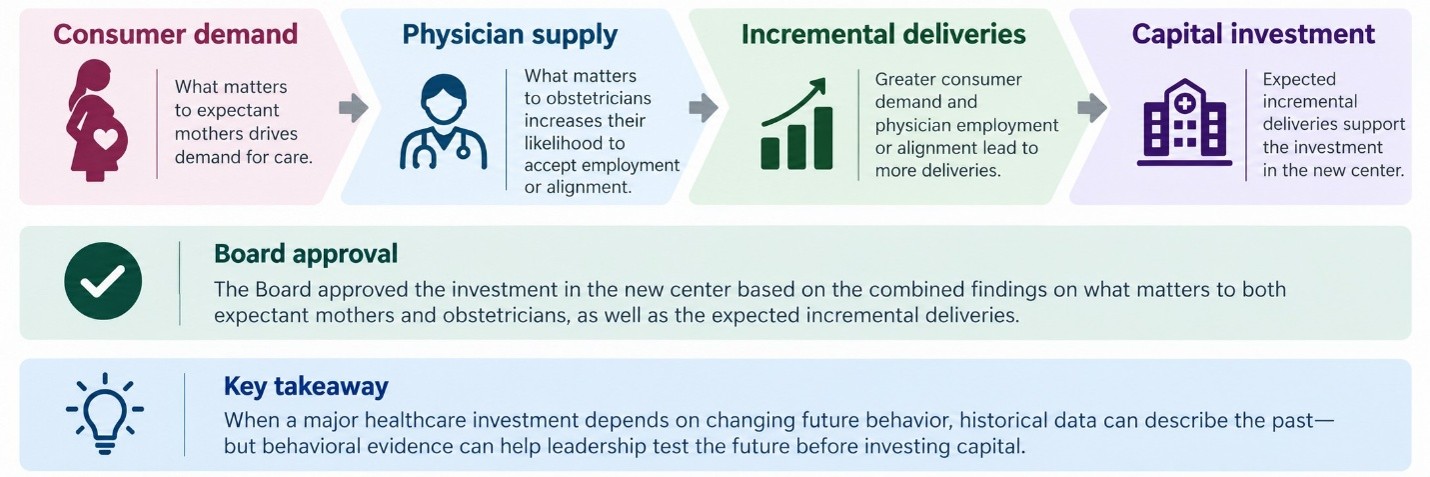
These choices provided new data for decision-making. By simulating future scenarios, leadership could now estimate market share, incremental deliveries, and volume shifts across competing hospitals.
Replacing Assumptions with Decision-Ready Evidence
The simulations provided leaders with market scenarios for comparing against the project’s financial requirements. They also identified the factors most likely to motivate families to switch hospitals, helping executives assess the conditions needed for success. Behavioral decision intelligence turned a twenty-year discussion into a Board-level investment decision grounded in evidence.
The Strategic Value of Knowing What Matters Before Building
Major capital investments often stall when leaders cannot estimate demand in markets that do not yet exist. Behavioral decision intelligence shows where patients are likely to choose tomorrow—and what will influence those choices. For healthcare executives, that can turn a speculative capital debate into a disciplined investment decision.
In the next article in the series, Who Decides. What Matters, we will share what mattered to expectant mothers in Getting to Yes.
Mi4Sight® is Market Innovations, Inc.’s behavioral economics modeling solution. Built on more than 20 years of experience and 135 healthcare studies, it helps leaders test innovative hypotheses, quantify likely behavior, and evaluate investments before committing capital.
To learn more, visit Mi4Sight | Market Innovations Inc.