
From Market Health to Decision Intelligence: A New Imperative for Healthcare Leadership

From Market Health to Decision Intelligence: A New Imperative for Healthcare Leadership
Understanding physician and consumer preferences, service-line growth, vulnerability, and brand health is essential to better strategic decisions. Healthcare executives face a fundamental challenge: making forward-looking strategic decisions based on information that largely describes the past.
Market share, patient volumes, referral patterns, and financial performance remain essential management indicators. However, they cannot fully explain why physicians and consumers choose specific providers, how those preferences may change, or which investments will generate the greatest economic value.
For healthcare leaders, the critical question is not simply how a service line is performing but how healthy its competitive position is—and what leadership can do to strengthen it.
Market Health: Looking Beneath the Number
A service line can show strong historical growth while harboring significant competitive vulnerabilities. Conversely, a program with modest market share may have substantial untapped growth potential.
As discussed in MII's earlier article, The Decision-making-Blind-spot-for-Healthcare-Providers, referring physicians direct approximately 80% of total volume through referrals across many high-value specialty services, depending on the specialty and the complexity of care.
Understanding physician preferences is therefore essential for simulating service-line growth and vulnerability.
Six dimensions influence physician choice:
- Brand: Institutional reputation, clinical credibility, and confidence.
- Medical Care: Clinical expertise, outcomes, quality, and care coordination.
- Access: Appointment availability, referral processes, and timely treatment.
- Price and Billing: Financial considerations, reimbursement, insurance acceptance, and administrative complexity.
- Communications and Services: Responsiveness, information exchange, and physician support.
- Technology: Advanced equipment, treatment capabilities, and clinical innovation.
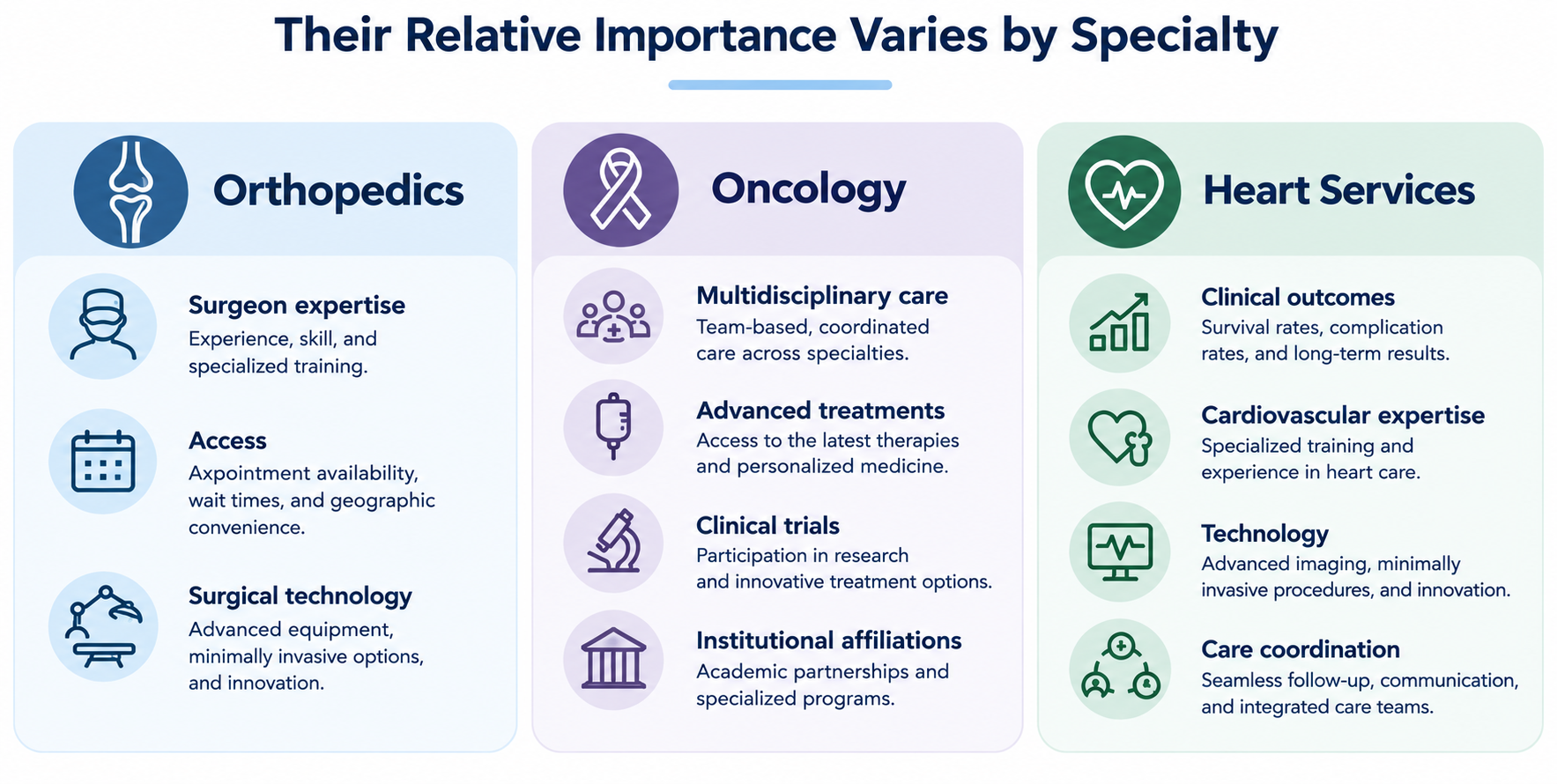
Applied behavioral economics quantifies how physicians weigh these attributes when choosing providers, revealing competitive strengths and vulnerabilities that conventional market analysis is not designed to measure.
Translating Market Health into Economic Value
Understanding competitive strengths and weaknesses is only the first step. The greater opportunity is to translate physician and consumer preferences into two critical economic measures:
Growth Potential: How much additional volume and contribution margin could a service line capture by strengthening its competitive position?
Economic Vulnerability: How much existing volume and contribution margin could be lost as physician and consumer preferences shift, or competitors improve their offerings?
An orthopedic program may find that improving access creates greater economic opportunity than expanding capacity. An oncology program may identify referral growth through stronger brand positioning or clinical affiliations. A heart program may uncover substantial vulnerability tied to shifting physician and consumer preferences or competing cardiovascular capabilities.
These insights are difficult to derive from historical performance alone, yet they are central to applied behavioral economics.
From Market Intelligence to Decision Intelligence
Decision Intelligence goes beyond identifying the factors that drive physicians' and consumers' choices. It predicts how they will respond to alternative strategies and translates those responses into economic outcomes.
Discrete choice experiments provide an analytical foundation. By presenting physicians and consumers with realistic alternatives that vary in clinical capabilities, access, technology, brand, and other attributes, discrete choice experiments can be used to build an analytical foundation and quantify the relative influence of each factor on provider selection. The resulting behavioral models enable executives to simulate strategic alternatives well before committing resources.
Would improving orthopedic access generate more economic value than acquiring new surgical technology? Would an oncology affiliation drive greater referral growth than expanding clinical capabilities? Which cardiovascular investments would best protect existing referrals while attracting new ones?
Decision Intelligence connects predicted changes in physician choice to expected volume, contribution margin, investment requirements, and competitive risk.
The strategy that generates the greatest incremental volume may not deliver the greatest economic value when reimbursement, contribution margins, investment costs, and protection of existing business are considered.
A New Leadership Imperative
For healthcare CEOs, CFOs, and strategy executives, this marks a fundamental shift in strategic planning. Capital is constrained. Competition is intensifying. Strategic decisions have substantial financial consequences.
Historical performance shows leaders where their service lines have been. Market Health reveals the behavioral and competitive forces shaping their future. Decision Intelligence provides the missing link by simulating how strategic alternatives will affect physician behavior, service-line performance, and economic value.
Together, they create a more forward-looking approach to service-line strategy—helping healthcare leaders determine not only where to grow and what to protect, but also which decisions will generate the greatest sustainable economic value.
_________________________________________________________________________________
Mi4Sight® is Market Innovations, Inc.’s behavioral economics modeling solution. Built on more than 20 years of experience and 135 healthcare studies, it helps leaders test innovative hypotheses, quantify likely behavior, and evaluate investments before committing capital. To learn more, visit Mi4sight | Market Innovations Inc.
.