
What Matters to Physicians When Capital Investment Depends on Future Physician Supply

What Matters to Physicians When Capital Investment Depends on Future Physician Supply
In the recent Newsworthy article, "What Matters to Expectant Mothers: Turning Behavioral Evidence into Market Growth.", we presented findings that answer the question of what matters to consumers. Specifically, the article examined how expectant mothers choose where to deliver. The next question was whether the organization could recruit additional obstetricians to support the projected incremental volume.
The proposed center would combine the expertise of a world-class obstetrics service with full-spectrum pediatric subspecialty care. However, projected demand alone was insufficient to justify a major capital investment. Leadership needed evidence that they could attract enough obstetricians to support the business case—either through employment or voluntary alignment.
Rather than relying on historical recruitment patterns or stated intentions, which proved inadequate for predicting obstetricians’ interest in the new business model, MII designed two behavioral experiments to identify the drivers of obstetricians' decisions. The two physician segments we tested were: (1) physicians employed by the center and (2) physicians who had privileges at the center (and were aligned)
Forty-two obstetricians participated in the employment contract acceptance experiment, and 48 in the voluntary alignment agreement experiment. Twelve features were tested, with ten in the employment model and seven in the alignment model.
The results identified specific priority drivers for each physician segment/group
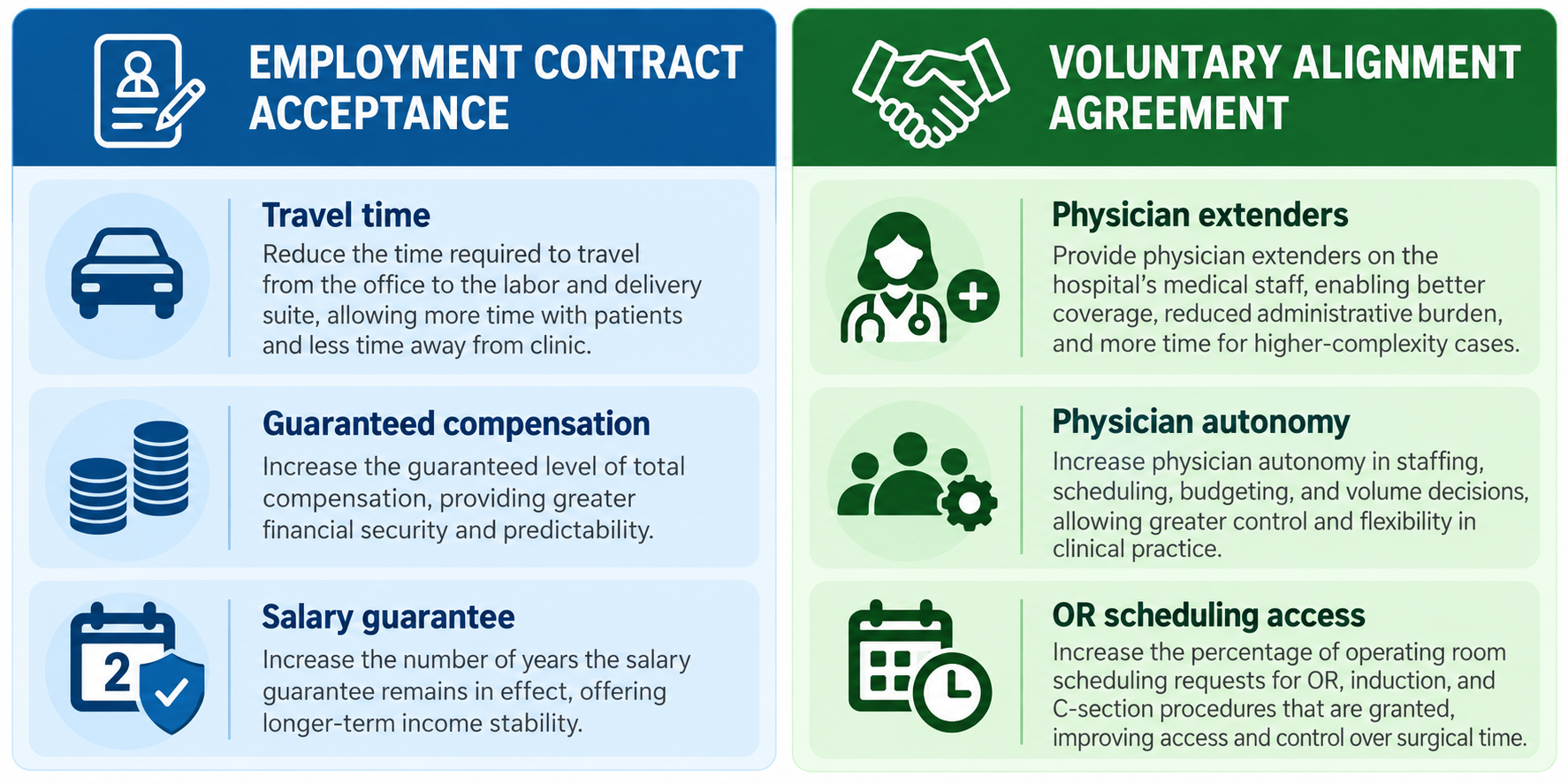
From What Matters to What Changes Behavior
The behavioral research went beyond identifying what physicians said they valued. It quantified how changes to the proposed offers could affect the likelihood of acceptance. Among the scenario simulations tested, the following illustrative results are presented for the employment contract and the voluntary alignment scenarios.
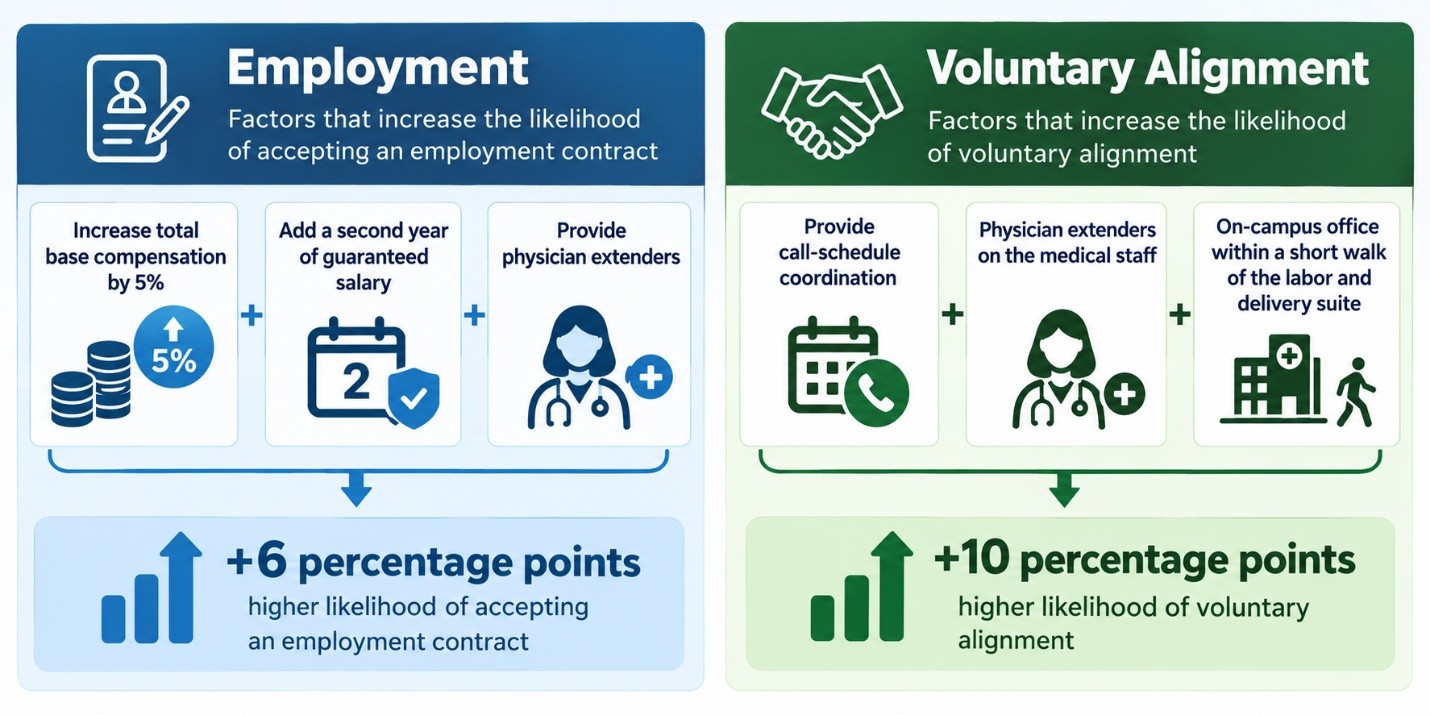
These findings gave leadership what historical data could not: a way to assess how specific investment and contract decisions might influence behavior before committing capital.
Connecting Demand, Physician Supply and Capital
The truly powerful insights are derived from integrating the two physician experiments with the earlier consumer research (What Matters to Expectant Mothers).
While the expectant-mother’s study identified what matters to families when choosing where to deliver and quantified the potential for incremental deliveries, the obstetrician's study identified what matters to physicians when deciding whether to work with or align with the organization and quantified how changes to the employment and alignment agreements could affect participation. Thus, both sides of the supply and demand economic/business equation were considered.
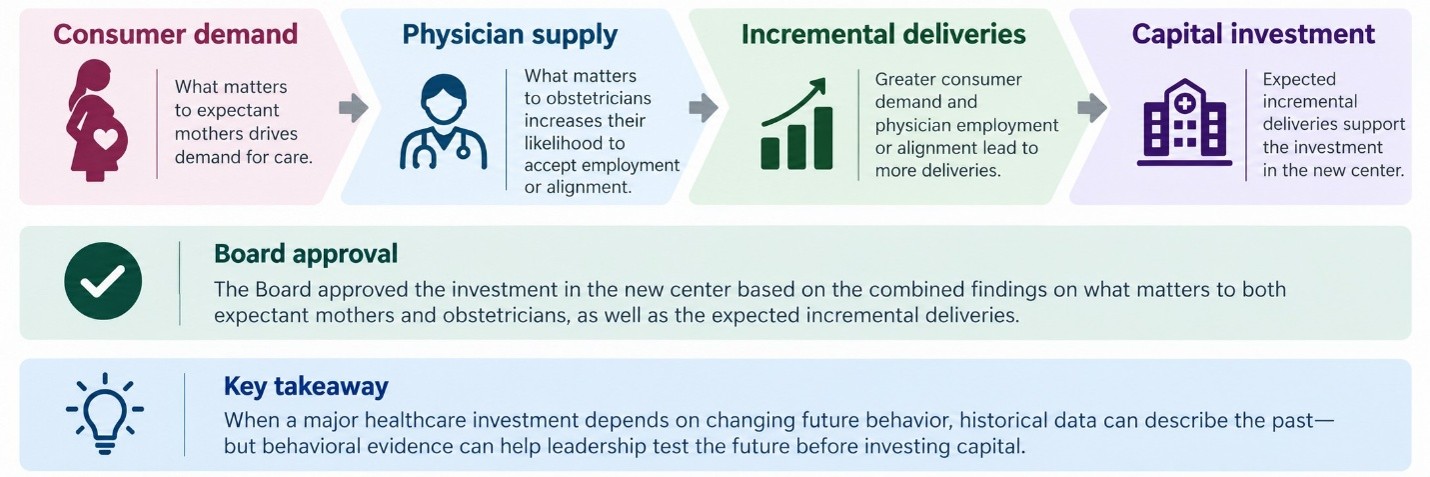
This changed the nature of the Board's decision. The proposed center was no longer supported solely by historical utilization, financial projections, or assumptions about physician participation. Leadership had behavioral evidence showing what mattered to the people who would determine whether the center could succeed—and how changes to the proposition could influence their decisions.
Learning extends beyond this center: when a major healthcare investment depends on changing future behavior, historical data can describe the past—but behavioral evidence can help leadership test the future before investing capital.
_________________________________________________________________________________
Mi4Sight® is Market Innovations, Inc.’s behavioral economics modeling solution. Built on more than 20 years of experience and 135 healthcare studies, it helps leaders test innovative hypotheses, quantify likely behavior, and evaluate investments before committing capital.
To learn more, visit Mi4sight | Market Innovations Inc.