
ENT OP Pricing Strategy
Case Study Key Business Question:
Would reducing prices for common ENT outpatient procedures drive sufficient incremental volume to maintain or improve net patient service revenue?
Client Situation
A leading academic hospital faced increasing payer pressure to reduce prices for high-volume ENT outpatient surgical procedures. Client benchmarking and anecdotal evidence provided by physicians indicated that the hospital’s charges exceeded those of local competitors, raising concerns that price premiums could limit physician referrals under tiered co-pays, narrow networks, and high-deductible benefit designs. Hospital leadership considered a significant price reduction to preserve referral volume but required a rigorous assessment of the market’s true price elasticity to provide insights about whether increased utilization would offset potential revenue losses.
Analytical Approach
Market Innovations, Inc. (MII) applied its Strategic Integrated Market Simulation (SIM2) methodology to quantify price elasticity of physician referrals. Several hundred referring physicians from the local market participated in an interactive, web-based study designed to replicate real-world referral decisions under alternative scenarios that included price as well as other features of the service they were referring for (e.g., medical care, access, communications). Demand models were generated from the choice sets responses to isolate the impact of price changes on referral behavior, enabling a direct assessment of volume response, revenue sensitivity, and downside risk.
Key Findings
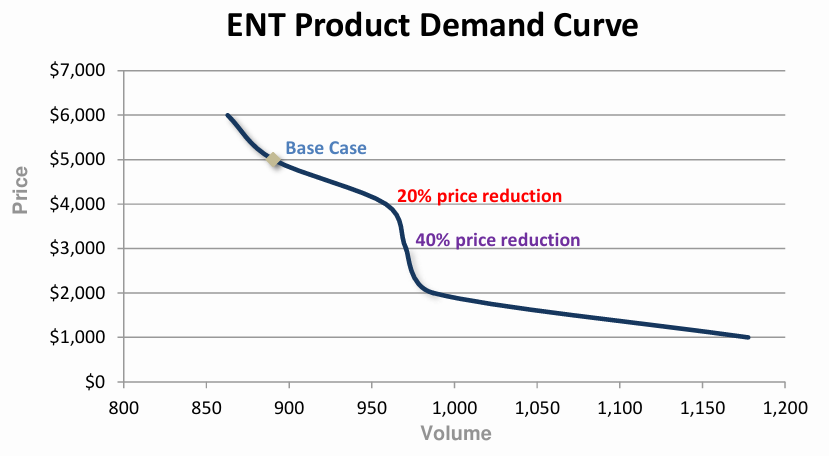
- ENT outpatient referral demand was moderately inelastic across the tested price ranges
- A 20% price reduction was projected to generate only a 4–8% increase in referral volume
- The resulting volume increase would not offset the price decrease, leading to an estimated $12–$16 million annual revenue decline
- Pricing was not a binding constraint in physician referral decisions for routine ENT outpatient procedures
Recommendations and Outcome
MII recommended that the hospital maintain current pricing for targeted ENT outpatient surgical procedures and avoid broad price reductions that would erode net patient service revenue without materially improving referral volume. SIM2-based elasticity modeling provided financial leadership with defensible, data-driven insight to prevent a well-intentioned but costly pricing decision.
As a result, the hospital leadership adopted the recommendation and did not implement pricing changes. This decision protected millions of dollars in annual revenue, preserved referral stability, and avoided unnecessary margin dilution.